


Categories
Buying, ComparisonsPublished January 7, 2026
Is Moving to Las Vegas Really a Tax-Smart Move?

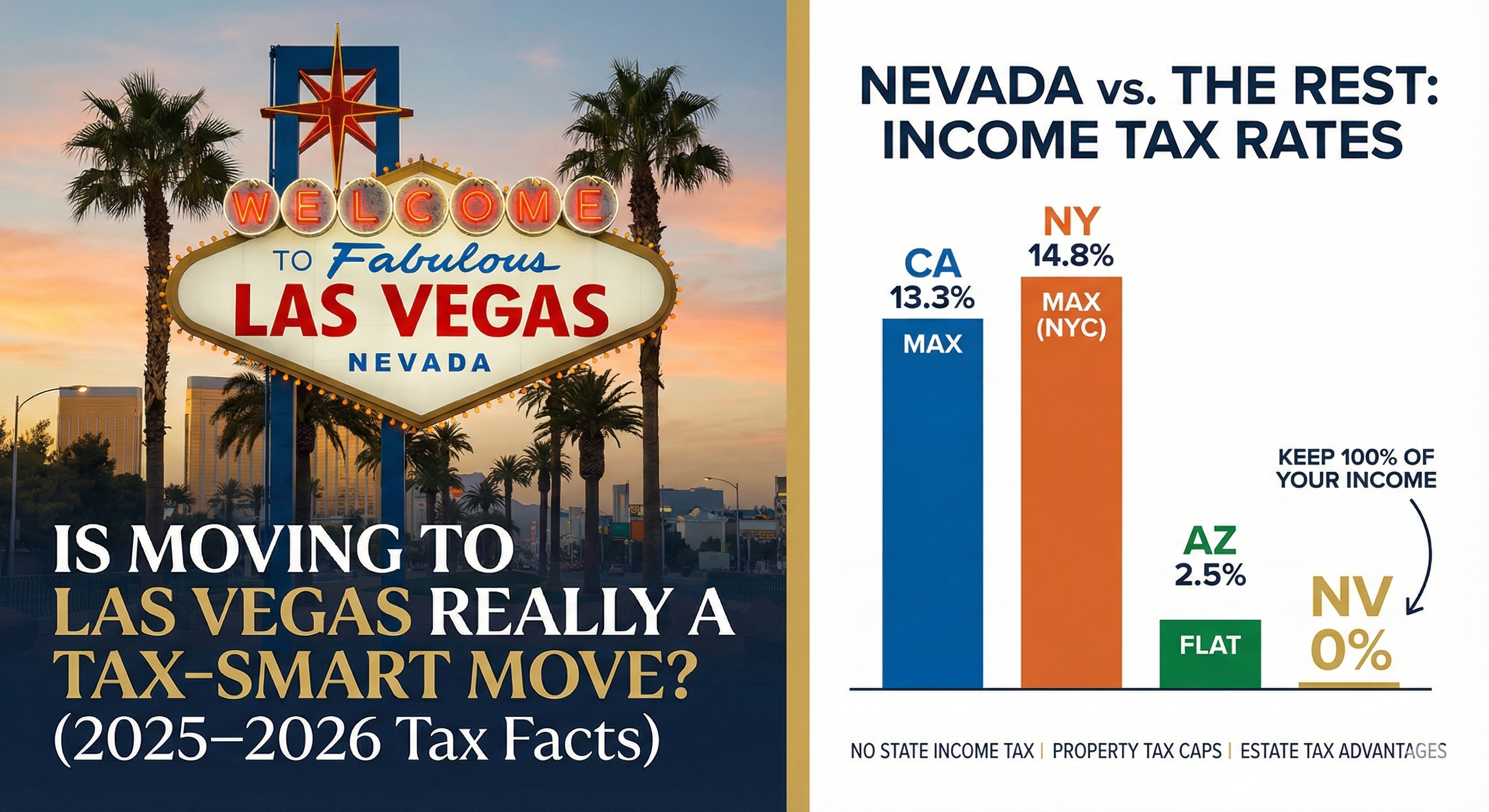
Is Moving to Las Vegas Really a Tax-Smart Move? (2025–2026 Tax Facts)
Imagine reviewing your annual income and find $18,000 missing. Not stolen, just state taxes. Like anyone else would, you Google "states with no income tax." Nevada appeared. Twice. Three times. Las Vegas kept showing up in your search results. So you asked the question everyone asks. "Is it really that much better?" Here's what the numbers actually say. Relocation decisions are financial decisions. When you're evaluating moving to Las Vegas for tax benefits, you need facts. This guide uses current data from the Nevada Department of Taxation, Clark County Assessor, IRS guidelines, and Tax Foundation rankings to compare Nevada's tax structure against California, New York, Arizona, Texas, and Washington. Important disclaimer: This is educational information, not tax, legal, or financial advice. Tax outcomes vary by individual circumstances. Consult a licensed CPA or tax attorney before making any relocation decisions.
What This Guide Covers
- State income tax (0% in Nevada) Property taxes (Clark County effective rates + caps)
- Sales tax realities (8.375% combined rate)
- Estate taxes (Nevada vs NY/WA)
- Business taxes (Commerce Tax + Modified Business Tax)
- Residency proof requirements
Why Las Vegas Keeps Showing Up on Relocation Lists in 2026
People move for many reasons: jobs, family, climate, housing affordability. But taxes increasingly drive the conversation. Migration patterns show consistent flows from California, New York, and Washington into Nevada. Las Vegas serves as the destination for roughly 75% of these movers, given its role as Nevada's economic center.
Nevada's tax structure isn't accidental—it's constitutional. Article 10 of the Nevada State Constitution prohibits a state income tax without voter approval. This has remained unchanged for decades. Because Nevada can't tax income, it relies heavily on sales tax, tourism levies, and selective business taxes to fund government operations.
Remote workers find this particularly appealing. If you can work from anywhere, why not keep your entire paycheck? Retirees also benefit: no state tax on Social Security, pensions, or 401(k) distributions. High earners see the largest absolute dollar savings, but the percentage benefit applies across all income levels.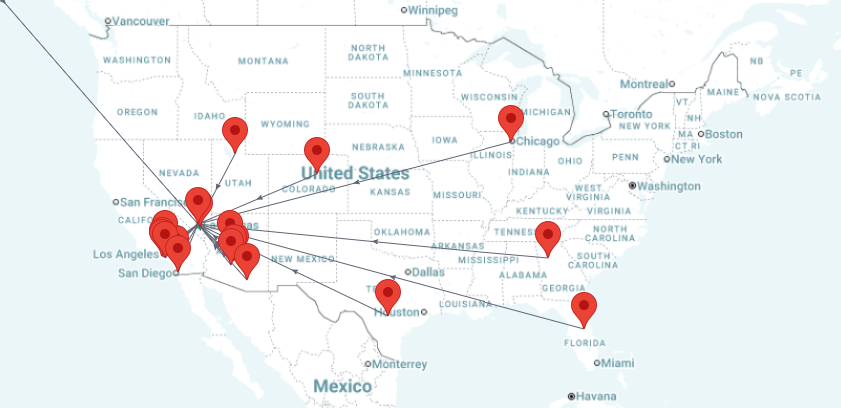
Clark County (home to Las Vegas, Henderson, and Summerlin) offers diverse housing stock and infrastructure that rural Nevada can't match. This combination—zero income tax plus urban amenities—explains why Las Vegas dominates relocation searches in 2026.
State Income Tax: The 0% Advantage (And How It Stacks Up)
Nevada's Zero State Income Tax Explained
Nevada has no state income tax on wages, salaries, dividends, or capital gains. You keep 100% of your income at the state level. Federal income tax still applies—FICA, Medicare, and federal brackets don't change based on where you live.
This zero-tax structure is codified in the state constitution. It would require a statewide voter referendum to change. For now, that seems unlikely given Nevada's political landscape and reliance on alternative revenue sources.
Remote workers who establish Nevada domicile avoid California or New York income tax on wages earned while physically working in Nevada. Retirees face no state tax on retirement distributions. High earners avoid progressive brackets entirely at the state level.
The California Comparison: 13.3% Top Rate
California's Franchise Tax Board enforces a progressive income tax ranging from 1% to 12.3%. Incomes exceeding $1 million face an additional 1% Mental Health Services Act surcharge, bringing the top rate to 13.3%. This makes California's top marginal rate the highest in the nation.
For context, a household earning $200,000 in California pays approximately $12,000–$15,000 in state income tax annually. The same household in Nevada pays $0. A $500,000 earner in California pays over $45,000 in state income tax—money that stays in your pocket if you live in Nevada.
California also conducts residency audits on high earners who claim to have left the state. The California Franchise Tax Board uses a "totality of circumstances" test to determine if you're still a California resident, even if you claim Nevada domicile. We'll cover residency proof requirements later.
New York's Double Bite: State + City Tax
New York State income tax ranges from 4% to 10.9%. But New York City residents face an additional city income tax of 3.078% to 3.876%. Combined, high earners in NYC face a top rate around 14.8%—the highest combined state/local income tax burden in the U.S.
A $250,000 household in New York City pays roughly $20,000–$25,000 in state and city income tax. That's $20,000+ in annual savings by establishing Nevada residency. Over a decade, that's $200,000+ retained—enough for a down payment, retirement contributions, or college savings.
Annual State Income Tax Savings by Moving to Nevada
Estimated annual savings based on 2025-2026 tax rates
$150,000 Household Income
vs. California $9,200
vs. New York $8,800
vs. Arizona $3,750
$300,000 Household Income
vs. California $26,500
vs. New York $24,000
vs. Arizona $7,500
$500,000 Household Income
vs. California $47,800
vs. New York $43,200
vs. Arizona $12,500
Estimates based on single filer using 2025-2026 state tax rates. Actual savings vary by filing status, deductions, and individual circumstances. NYC figures include city income tax. Texas and Washington have 0% income tax but higher property/capital gains taxes.
Arizona's Flat 2.5% Rate
Arizona switched to a flat 2.5% income tax effective for the 2024 tax year. This creates simplicity: all income levels pay the same percentage. A $150,000 household pays about $3,750 annually in state income tax.
While 2.5% is substantially lower than California's 13.3% or New York's combined 14.8%, it's still not zero. For someone earning $300,000, that's $7,500 annually—real money that Nevada residents keep.
Texas and Washington: Also Zero (With Caveats)
Texas has no state income tax, similar to Nevada. However, Texas compensates through significantly higher property taxes (covered in the next section). The Texas model trades income tax for property tax burden.
Washington has no income tax on wages or salaries. But Washington imposes a 7% capital gains tax on annual gains exceeding $250,000. Rates increased in 2025: 7% on gains up to $1 million, 9.9% on gains over $1 million. Technically an "excise tax" rather than an income tax, it functions similarly for investors and high-net-worth individuals.
For W-2 employees, Washington and Nevada are comparable. For investors realizing substantial capital gains, Nevada has the advantage.
State Income Tax Comparison 2026
| State | Tax Structure | Rate Range | Top Rate Details |
|---|---|---|---|
| Nevada | None | 0% | No state income tax |
| California | Progressive | 1% to 13.3% | 13.3% on income over $1M |
| New York | Progressive | 4% to 10.9% | NYC adds 3.078% to 3.876% |
| Arizona | Flat | 2.5% | All income levels |
| Texas | None | 0% | No state income tax |
| Washington | None (wages) | 0% / 7%–9.9% | Capital gains tax on high earners |
The Nevada vs California tax comparison 2026 is stark: California's top earners pay over 13%, Nevada residents pay nothing. For many relocating professionals, this single factor justifies the move.
Property Taxes in Clark County: The Nuance Behind the Numbers
How Property Tax Works in Nevada
Property tax in Nevada is calculated on assessed value, which equals 35% of your property's taxable value. The Clark County Assessor determines taxable value based on market conditions and property characteristics. The Clark County Treasurer then bills and collects the tax.
Tax rates are expressed per $100 of assessed value. In Clark County, the combined rate is approximately $3.28 per $100 of assessed value. This translates to an effective rate of about 0.51% to 0.53% of your home's market value, depending on your specific tax district.
Example: A $500,000 home has a taxable value of $500,000. The assessed value is 35% of that, or $175,000. At $3.28 per $100, the annual property tax is roughly $2,550–$2,650.
The 3% Cap for Primary Residences
Nevada law caps annual property tax increases at 3% for primary residences and 8% for other properties (investment, commercial, vacant land). This is often called the "abatement cap" under AB 489 and Nevada Revised Statutes Chapter 361.
Critically, this cap applies to your tax bill, not your home's assessed value. Even if your home's value increases 15% in a hot market, your property tax bill can only rise by 3% annually if you qualify for the primary residence abatement.
To qualify, you must file a declaration with the Clark County Assessor within 45 days of purchasing. The property must be your primary residence—your domicile. As long as you remain the owner-occupant, the 3% cap continues.
Nevada Property Tax Cap Mechanics
| Property Type | Annual Tax Cap | Qualification |
|---|---|---|
| Primary Residence | 3% | Must be owner-occupied; file with Assessor |
| Investment Property | 8% | Non-primary residence |
| Commercial Property | 8% | Business-use property |
| Vacant Land | 8% | No residence |
Property Tax Comparison: Nevada vs Other States
Nevada's effective property tax rate sits in the middle range nationally. Arizona has the lowest among comparison states at 0.43%–0.45% (fourth lowest in the U.S.). California averages 0.68%, with Proposition 13 limiting assessed value increases to 2% annually—similar philosophy to Nevada's cap but different mechanics.
Texas has some of the highest property taxes in the nation: 1.47%–1.80% effective rate. Texas uses property tax as its primary revenue source since it has no income tax. A $500,000 home in Texas often incurs $7,000–$9,000 annually in property tax—nearly triple Nevada's amount.
New York varies dramatically by region. The state average is 1.38%–1.64%. Upstate counties can reach 2.7%–4% effective rates. Even in NYC (0.88%–1.2%), a $500,000 property pays significantly more than in Las Vegas.
Washington averages 0.79%–0.84%. King County (Seattle) has a median annual property tax of $6,785. While Washington has no income tax, its property tax burden exceeds Nevada's.
Annual Property Tax on a $500,000 Home
Comparison across six states (2025-2026 effective rates)
Arizona 0.43–0.45%
$2,200Nevada (Las Vegas) 0.51–0.53%
$2,600California 0.68%
$3,400Washington 0.79–0.84%
$4,100New York 1.38–1.64%
$7,500Texas 1.47–1.80%
$8,200💡 Nevada Advantage: Las Vegas property tax is 3.2× lower than Texas and 2.9× lower than New York on a $500K home.
🛡️ Protection: Nevada's 3% annual cap means your $2,600 bill can only increase to $2,678 next year—even if your home value jumps 20%.
Figures represent midpoint estimates based on state/county averages for a $500,000 primary residence. New York figure is state average; NYC rates are lower (0.88–1.2%) but upstate can reach 2.7–4%. Texas has no state income tax but relies heavily on property tax. Actual bills vary by specific tax district and property characteristics.
The 3% cap provides long-term predictability. If you buy a $500,000 home in Las Vegas with a $2,600 annual tax bill, it can only rise to $2,678 next year, $2,758 the following year, and so on—regardless of market appreciation. This protection is valuable during housing booms.
Sales Tax in Las Vegas: The 8.375% Reality
Breaking Down the Combined Rate
Nevada's state sales tax is 4.6%, as set by the Nevada Department of Taxation. Clark County adds local option taxes, bringing the combined rate to 8.375% in Las Vegas. The breakdown: 4.6% state + 3.775% county/local.
This rate applies to most retail goods: clothing, electronics, furniture, home improvement supplies. Restaurant meals are also taxable. Importantly, Nevada taxes food for home consumption (groceries), unlike California, which exempts unprepared food.
For context, if you spend $10,000 annually on taxable purchases, you'll pay $837.50 in sales tax. If you're a high-spending household ($50,000 in taxable purchases), that's $4,187.50 annually.
How Nevada Compares
California (Los Angeles): 9.75% combined rate (increased April 2025 due to Measure A). New York (NYC): 8.875% combined. Arizona (Phoenix): 8.6%. Texas (Houston, Dallas): 8.25%. Washington (Seattle): 10.35%—among the highest in the nation.
Las Vegas sits in the middle: higher than Texas and Arizona, lower than California and Washington. It's not the lowest, but it's also not an outlier.
The Sales Tax Trade-Off
"Nevada funds government services primarily through sales tax and tourism levies, not income tax. This means you pay more when you spend, but you keep your entire paycheck. Whether this benefits you depends on your income level and spending habits."
What's Taxable and What's Not
Generally taxable: Retail goods, restaurant meals, hotel stays, entertainment tickets, vehicle purchases. Generally exempt: Prescription drugs, certain medical devices. Notable difference: Nevada does not exempt groceries, while some states do. Nevada generally does not tax most services (legal fees, accounting, haircuts), unlike some states that have expanded sales tax to services.
If you're relocating from a state with no sales tax on groceries, budget accordingly. A family spending $1,000 monthly on groceries will pay an additional $83.75 monthly ($1,005 annually) in Nevada sales tax.
Estate and Inheritance Taxes: Protecting Generational Wealth
Nevada's Advantage: Zero State Estate Tax
Nevada has no state estate tax and no inheritance tax. Only the federal estate tax applies. For 2026, the federal estate tax exemption is $15 million per individual (increased from $13.99 million in 2025 under the One Big Beautiful Bill Act). Married couples can combine exemptions for a total of $30 million with portability.
The federal estate tax rate is 40% on amounts exceeding the exemption. For most families, estates fall well below this threshold. Nevada's lack of state-level estate tax simplifies planning and avoids double taxation.
New York's Estate Tax Cliff
New York imposes a state estate tax with a $7.16 million exemption (2025 figure; adjusted annually). New York's unique "tax cliff" creates a harsh penalty: if your estate exceeds 105% of the exemption ($7.518 million in 2025), the entire estate is taxed, not just the excess.
Example: A $7.2 million estate in New York pays roughly $108,000 in state estate tax. A $7.16 million estate pays $0. A mere $40,000 difference in estate value creates over $100,000 in tax liability. This cliff structure requires careful planning.
New York's estate tax rates range from 3.06% to 16%, graduated by estate size.
Washington's Steep Estate Tax
Washington state has a $3 million estate tax exemption (effective July 1, 2025—recently increased from $2.193 million). Washington's rates were dramatically increased in 2025: the top rate jumped from 20% to 35%.
Combined with the federal estate tax (40%), large estates in Washington face a maximum marginal rate around 61%. Unlike the federal exemption, Washington's exemption is not portable between spouses.
For estates between $3 million and $15 million, Nevada offers substantial estate planning advantages. A $10 million estate in Nevada faces zero state estate tax and zero federal tax (under the exemption). The same estate in Washington faces state tax on $7 million at graduated rates up to 35%.
Estate Tax Comparison 2026
| State | State Estate Tax? | Exemption | Top Rate | Notes |
|---|---|---|---|---|
| Nevada | No | N/A | N/A | Federal only |
| California | No | N/A | N/A | Federal only |
| Arizona | No | N/A | N/A | Federal only |
| Texas | No | N/A | N/A | Federal only |
| New York | Yes | $7.16M | 16% | Tax cliff at 105% |
| Washington | Yes | $3M | 35% | Non-portable |
Business Taxes in Nevada: What Entrepreneurs Should Know
Nevada Commerce Tax
The Nevada Commerce Tax (Nevada Revised Statutes Chapter 363C) is a gross receipts tax on businesses with Nevada gross revenue exceeding $4 million annually. It's calculated on your Nevada revenue, not profit. Rates vary by industry classification (NAICS code), ranging from 0.051% to 0.331%.
Example: A retail business with $6 million in Nevada gross revenue pays tax on $2 million ($6M minus the $4M threshold). At the retail rate of 0.111%, that's $2,220 annually.
Businesses with revenue under $4 million pay zero Commerce Tax. This exempts most sole proprietors, freelancers, and small businesses.
Modified Business Tax (MBT)
Nevada's Modified Business Tax is a payroll tax on employers. The rate is 1.17% for general businesses and 1.554% for financial institutions. It applies to quarterly wages exceeding $50,000 (or $200,000 annually).
The first $50,000 per quarter is exempt, so smaller employers with limited payroll often pay little to no MBT.
No Corporate Income Tax
Nevada has no corporate income tax at the state level. LLCs, S-corps, and C-corps do not pay state tax on profits. This distinguishes Nevada from California (8.84% corporate rate) and New York (7.25% corporate rate).
Businesses must still file with the Nevada Tax Center and pay federal taxes. Nevada's structure favors small to mid-sized businesses with manageable payroll and revenue under the Commerce Tax threshold.
Does the Commerce Tax Affect You?
"If your business generates less than $4 million in Nevada gross revenue annually, you do not owe Nevada Commerce Tax. Most sole proprietors, freelancers, and small business owners are exempt."
For those researching Las Vegas tax relocation services, note that establishing business domicile involves filing with the Nevada Secretary of State, obtaining a business license, and potentially registering with the Nevada Tax Center if you exceed thresholds. Consult a business tax advisor for guidance.
Proving Residency: Why "Domicile" Matters (And How to Establish It)
The California Franchise Tax Board Residency Audit Risk
If you're leaving California, understand that the California Franchise Tax Board audits high earners who claim Nevada residency. California uses a "totality of circumstances" test to determine domicile. Even if you live in Nevada, California may argue you're still a California resident if you maintain significant ties
About the Author
Gavin Brenkus | Lead Agent & Director of Lead Generation
A three-time recipient of the prestigious "Who's Who Under 40" award from Las Vegas REALTORS®, Gavin Brenkus has firmly established himself as one of the most accomplished real estate professionals in Southern Nevada. As a Lead Agent and the Director of Lead Generation for The Brenkus Team, he is an integral part of a family-owned legacy that has achieved nearly $2 billion in sales volume and successfully closed over 8,000 transactions.
For Gavin, real estate is more than a profession—it's a lifelong passion. Immersed in the industry from the age of 16 and licensed before graduating high school, he offers a rare depth of market knowledge that combines youthful energy with decades of absorbed expertise.
His professional philosophy is built on a foundation of listening. Gavin is dedicated to fully understanding the unique wants and concerns of his clients, allowing him to curate a tailored and seamless experience from start to finish. This client-first approach ensures that everyone he works with feels heard, valued, and expertly guided.

Brenkus Team
| The Brenkus Team | Keller Williams Realty The Marketplace


or another way