

Categories
Selling, ComparisonsPublished October 1, 2026
Best Real Estate Agent in Green Valley Ranch? 9 Things Sellers Should Compare Before Choosing

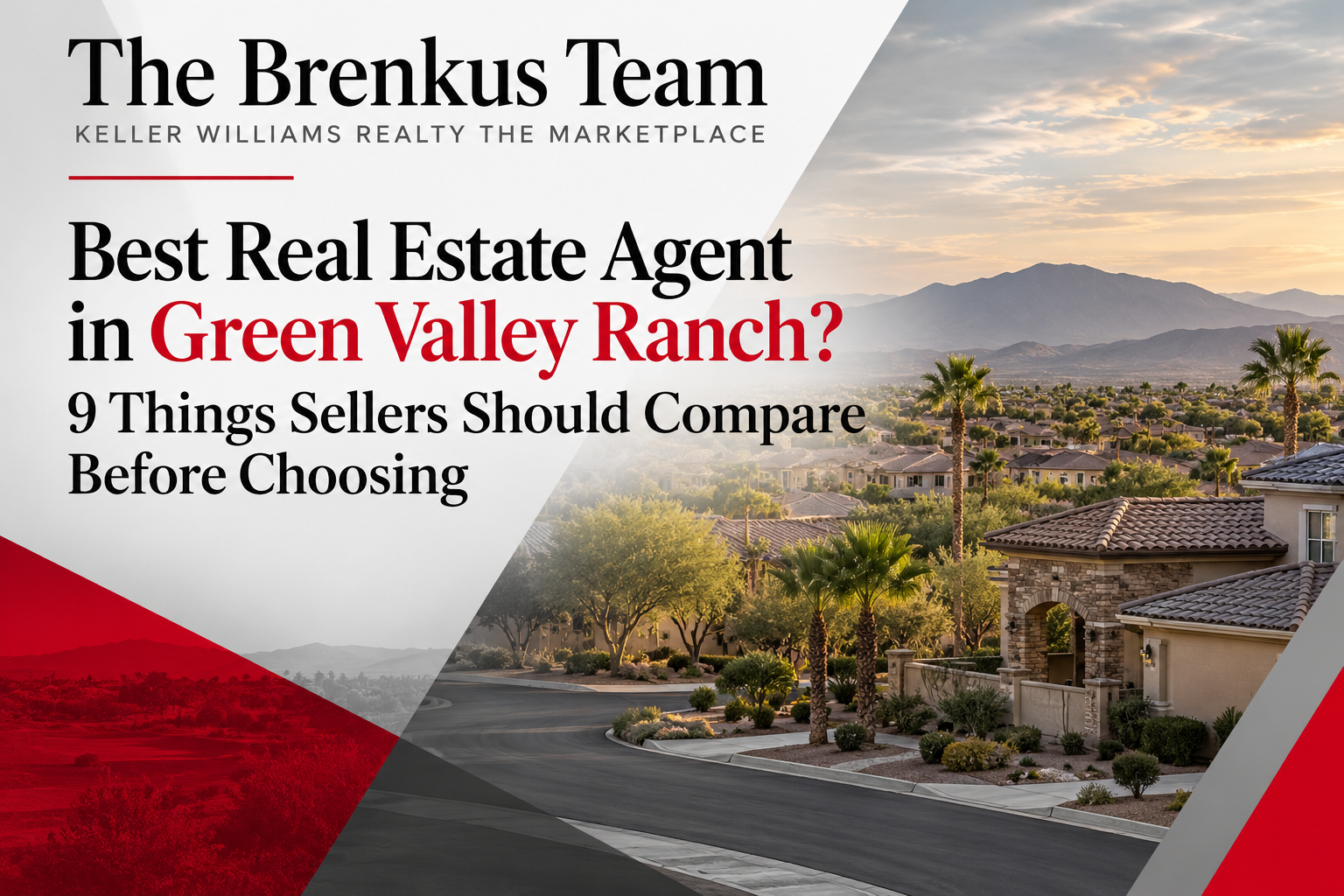
Best Real Estate Agent in Green Valley Ranch? 9 Things Sellers Should Compare Before Choosing
In a housing market where over 41% of active Green Valley Ranch listings are forced to reduce their asking price, choosing listing representation based on charm, polished slogans, or vague superlatives is an expensive gamble.
Selling a home in an established master-planned community—with dual-HOA disclosure rules, aging mechanical lifecycles, and shifting buyer financing terms—demands verifiable operational competence.
Before you sign an exclusive listing agreement, here are the nine objective criteria every Green Valley Ranch homeowner must compare, along with the exact documentation you should demand.
Understanding the August 2026 Micro-Market
Before evaluating individual agents, it is essential to anchor your expectations in current micro-market data. Broad national headlines and valley-wide Las Vegas metrics obscure what is actually happening inside the 1,310 acres of Green Valley Ranch.
According to August 2026 MLS data published by Redfin Market Trends, Green Valley Ranch functions as a distinct, premium micro-market within Henderson. It commands higher median equity and absorbs faster than the municipality as a whole, yet it demonstrates intense buyer resistance to speculative overpricing.
- GVR Median Sale Price: $599,711 (a 21.05% premium over Henderson's citywide median of $495,422)
- GVR Price Per Square Foot: $289/sq ft (up 7.0% year-over-year, versus $257/sq ft citywide)
- Median Days on Market (DOM): 43 days (15 days faster than the Henderson municipal median of 58 days)
- Price Reduction Share: 41.4% of active residential listings had at least one price drop
This snapshot illustrates the central paradox facing Green Valley Ranch sellers today: demand for the neighborhood is robust, but today’s buyers refuse to overpay. Pricing your home even 3% above fair market value can cause your listing to stagnate while competing inventory absorbs around you.
Navigating this terrain requires an agent whose strategy is driven by granular neighborhood analytics rather than guesswork.
1. Relevant Local Experience: Henderson Broad vs. Green Valley Ranch Specific
Evaluating a listing agent’s local experience requires looking beyond broad Henderson sales or generic ZIP code totals. A qualified Green Valley Ranch listing agent must demonstrate an active transaction history within the master plan's specific subdivisions, an active license in good standing with the Nevada Real Estate Division, and firsthand experience managing local contract contingencies across varying market cycles.
Many agents market themselves as "Henderson specialists." But Henderson spans over 107 square miles, encompassing master plans as diverse as Anthem, Inspirada, Cadence, and Lake Las Vegas. Even looking at ZIP codes can be deceptive: 89052 and 89012 extend well past the physical boundaries of Green Valley Ranch, taking in high-density commercial corridors and hillsides with entirely different zoning, tax assessments, and buyer dynamics.
Green Valley Ranch, established in 1994 by American Nevada Corporation, has its own micro-pockets. A single-story property near Paseo Verde Park carries different valuation variables and appeals to different buyers than a custom two-story estate located in a gated enclave near The District.
When interviewing agents, ask for tangible evidence of submarket competence:
- Ask for an audited list of closed sales within Green Valley Ranch over the past 24 to 36 months.
- Ask how many transactions they have managed through changing interest-rate environments.
- Verify their licensure status on the public state registry.
The Evidence Standard: Longevity in Southern Nevada provides crucial perspective during market shifts. For example, Rick Brenkus of The Brenkus Team at Keller Williams Realty The Marketplace (located at 2230 Corporate Circle in Henderson) has held continuous active Nevada licensure since 1985 (Broker-Salesperson License #BS.0016186.LTD). Independent audit records from third-party directories like FastExpert document 556 closed Southern Nevada transaction sides over a recent three-year audit period.
Knowing the neighborhood's streets is step one; navigating the complex governing associations that oversee those properties is step two.
2. Community & HOA Knowledge: Navigating GVR’s Dual-Association Structure
Green Valley Ranch operates under a dual-HOA model comprising the master Green Valley Ranch Community Association (GVRCA) and 31 to 32 individual sub-associations. Under NRS 116.4109, sellers must provide disclosure packages for each applicable association. Buyers hold an unconditional, non-waivable 5-day statutory right to cancel the contract upon receiving these documents, making proactive document ordering critical to transaction security.
Selling in Green Valley Ranch is rarely as simple as ordering a single HOA statement. If your home is located within one of the community's 16 to 18 gated or guard-gated subdivisions, your transaction is governed by two separate entities:
- The Master Association (GVRCA): Manages community-wide architectural guidelines, master common elements, and shared landscape corridors.
- The Sub-Association: Governs local neighborhood gates, private streets, community pools, and sub-association reserve funds.
Under Nevada law, the seller must provide the buyer with an official resale package containing association declarations, bylaws, operating budgets, reserve study summaries, and any notices of open violations.
The transaction risk lies in the statutory review clock:
HOA Resale Documents & Buyer Review Timeline
Sequential delivery workflow and statutory cancellation window breakdown under Nevada Law
5 Days
Statutory Rescission Window
100%
Unconditional Cancellation Right
NRS 116.4109
Governing Nevada Statute
1
Mutual Contract Acceptance Step 01
Buyer and seller sign the purchase agreement. The clock does NOT start for the buyer's HOA review period at this milestone.
2
Seller Orders Resale Packages Step 02
Seller orders official HOA resale packages for both Master and Sub-HOA (if applicable). Ordering delays extend total exposure time for the seller.
3
Delivery to Buyer Trigger Point
Both full HOA packages are physically or electronically delivered to the buyer. This complete delivery officially triggers the statutory clock.
4
5-Day Statutory Rescission Period NRS 116.4109
Buyer has 5 calendar days after receipt of all HOA document packages to review and unconditionally cancel the contract without penalty.
5
Contingency Cleared / Escrow Proceeds Final Stage
Once the 5-day rescission period expires without cancellation, the HOA contingency is officially cleared and escrow moves forward to closing.
Critical Takeaway for Sellers: A buyer's 5-day unconditional contract cancellation right does not begin until both HOA resale packages are physically or electronically delivered. Delays by the seller in ordering packages artificially extend the buyer's walk-away window.
If an inexperienced agent waits three weeks into escrow to request these resale packages, the buyer's 5-day rescission clock does not begin until week four. If market sentiment softens or the buyer experiences remorse, they can cancel the contract without penalty on day 25 and recover their entire earnest money deposit.
What to demand from an agent:
- Ask for their written protocol and timeline for ordering both master and sub-HOA resale packages.
- Inquire how they verify whether your property has open architectural infractions (such as paint fade or unapproved tree removals) before the HOA resale inspection occurs.
Understanding community governance keeps escrows intact, but establishing your property's value requires a rigorous pricing methodology.
3. Pricing and Comparative Market Analysis (CMA) Strategy: Data vs. Flattery
A defensible Comparative Market Analysis (CMA) in Green Valley Ranch must evaluate recent closed sales, active competition, and pending contracts within the same sub-association or immediate micro-pocket. Credible CMAs make objective adjustments for single-story floor plans, lot elevation, Strip views, private swimming pools, and gated access rather than relying on automated algorithm estimates.
The oldest trap in real estate is "buying the listing." An agent presents an artificially inflated property valuation to flatter your expectations and secure your signature on an exclusive listing agreement.
Weeks later, after the listing has grown stale and buyers have moved on, the agent asks for a substantial price reduction.
Automated Valuation Models (AVMs) found on national property portals cannot distinguish between a home backing up to a busy thoroughfare like Green Valley Parkway and an identical floor plan situated on an elevated cul-de-sac with views of the Las Vegas Strip.
A defensible CMA relies on four distinct layers of local market evidence:
- Closed Comps (Past 90–180 Days): What certified appraisers and qualified buyers have verified with real capital.
- Active Competition: The alternative properties currently fighting for the same buyers you need to attract.
- Pending Sales: Real-time contracts that show where the market is moving right now.
- Expired & Canceled Listings: The exact price thresholds that Green Valley Ranch buyers recently rejected.
- "Did you pull comps strictly from my sub-association and comparable GVR subdivisions, or did you mix in data from across Henderson?"
- "What specific, market-tested adjustments did you assign to our single-story floor plan versus two-story models?"
- "How does our proposed asking price position us against current active listings that have already cut their prices?"
- "Can you show me the last three homes that failed to sell in our price bracket in Green Valley Ranch, and explain why the market rejected them?"
A pricing analysis should be a mathematical presentation, not an exercise in sales flattery. But even the best pricing model must reflect broader market conditions.
4. Understanding Current Market Conditions: Experience vs. Modern Velocity
In August 2026, Green Valley Ranch recorded a median home price of $599,711 ($289/sq ft), reflecting a 21.05% premium over Henderson’s municipal median of $495,422. While GVR homes sold in a brisk median of 43 days (15 days faster than Henderson overall), 41.4% of active listings underwent price reductions, demonstrating extreme buyer resistance to overpricing.
An agent with 20 years of experience who does not track week-to-week inventory shifts can damage your bottom line just as quickly as a novice. Real estate experience is only valuable when paired with an accurate reading of today's absorption rates.
Consider the divergence between Green Valley Ranch and the city of Henderson as a whole:
Green Valley Ranch vs. Henderson — Current Market Snapshot
August 2026 Housing Market Performance & Seller Benchmarks
$599,711
GVR Median Price
+$104,289
Price Premium (+21.1%)
15 Days
Faster Selling Speed
+7.0% vs -1.9%
YoY Price Growth
← Scroll horizontally to view full market table →
| Market Metric | Green Valley Ranch (Aug 2026) |
Henderson Citywide (Aug 2026) |
Strategic Takeaway for Sellers |
|---|---|---|---|
| Median Sale Price |
$599,711 PREMIUM
|
$495,422
|
GVR commands a substantial equity premium of +$104,289 (+21.05%) over the broader citywide median. |
| Price Per Square Foot |
$289 / sq ft
+7.0% YoY
|
$257 / sq ft
-1.9% YoY
|
GVR appreciated +7.0% YoY, demonstrating resilient local demand while Henderson citywide softened -1.9% YoY. |
| Median Days on Market |
43 Days FASTER
|
58 Days
|
GVR inventory moves significantly faster, selling 15 days quicker than the Henderson citywide average. |
| Share of Price Drops |
41.4% SENSITIVE
of active listings
|
39.8%
of active listings
|
Elevated price cuts across both markets underscore that high buyer price sensitivity requires precise initial pricing strategies. |
What does this data tell us?
Green Valley Ranch possesses remarkable resilience and steady buyer demand. However, the high price-reduction rate (41.4%) shows that sellers who price according to where they wish the market was are getting penalized. In a market where inventory moves in 43 days, an overpriced home sits visible, accumulates days on market, and eventually sells at a steeper discount than if it had been priced accurately on day one.
What to demand from an agent:
- Ask to see their current month-over-month absorption analysis for your specific price tier in Green Valley Ranch.
- Ask for their average list-to-sale price ratio on closed listings over the past 12 months.
Once your pricing strategy is grounded in current data, you must address the physical reality of your asset.
5. Strategic Pre-Listing Preparation: Prioritizing High-ROI Repairs
Homes in Green Valley Ranch were largely constructed between 1994 and 2002, placing major mechanical systems—such as HVAC units, original plumbing valves, and tile roof underlayment—near or past their typical service lives. A strategic listing agent identifies pre-listing inspection red flags to prevent renegotiations without encouraging wasteful, unrecoupable capital expenditures.
There is a major difference between preparing a home for market and over-improving it.
An inexperienced agent often hands the seller an expensive renovation checklist: gutting kitchens, replacing counters with trendy quartz, or installing luxury vinyl plank flooring throughout. These major capital outlays rarely yield a dollar-for-dollar return at closing.
A seasoned listing agent focuses on deferred maintenance and visual appeal:
- Inspection Risks: Desert heat degrades mechanical components. Evaluating the serviceability of original air conditioning systems, water heaters, and tile roof underlayment before listing prevents aggressive repair requests or credit demands during the buyer's due diligence period.
- Targeted Cosmetics: Fresh, neutral interior paint, professional desert landscape cleanup, deep tile-and-grout restoration, and modernized cabinet hardware provide immediate, measurable returns without draining your capital reserves.
- Staging and Flow: Decluttering to accentuate architectural volume, maximizing natural light, and clarifying room functionality helps prospective buyers visualize the space easily.
What to demand from an agent:
- Ask for a written, prioritized pre-listing walk-through assessment that clearly categorizes recommendations into:
- Mandatory repairs (items that will likely derail buyer underwriting or home inspection contingencies).
- High-ROI aesthetic adjustments (low-cost improvements that elevate presentation).
- Items to leave alone (expensive updates that will not return their cost).
Once the property is properly prepared, it must be presented to the market with professional execution.
6. Marketing and Property Presentation: Visual Assets and Distribution
Modern listing presentation requires professional architectural photography, accurate digital floor plans, cinematic video tours, and targeted distribution. Following the August 2024 NAR settlement rules, an agent’s marketing strategy must also leverage compliant direct buyer outreach, verified broker networks, and syndication platforms rather than relying exclusively on passive Multiple Listing Service entries.
Nearly all home buyers begin their property search online. Yet many agents still take wide-angle smartphone photos, write a brief property description, upload the listing to the local MLS, and simply wait for showings.
Passive MLS syndication is not a comprehensive marketing plan. Serious marketing requires professional media production tailored to high-equity master-planned properties.
Marketing Promise vs. Evidence to Request
A Seller's Due Diligence Checklist for Evaluating Real Estate Agent Claims
4 Common Claims
3D & Floor Media Standard
100% Audit Required
Henderson Local Proof
← Scroll table horizontally to view full comparison →
| Common Agent Promise | What It Usually Means | Verifiable Evidence Sellers Should Request |
|---|---|---|
| Claim 1 "We provide professional photography." |
A contractor taking rapid HDR shots with excessive wide-angle distortion. | Verification Check Review 3 active listing portfolios showing true architectural composition, accurate color balance, and twilight visuals. |
| Claim 2 "We include virtual media." |
An automated slideshow of static photos set to generic music. | Verification Check Inspect a live interactive 3D virtual tour and a measured schematic floor plan with interior dimensions. |
| Claim 3 "Your home will be featured everywhere online." |
Standard, automated IDX syndication to sites like Zillow and Realtor.com. | Verification Check Request a written digital distribution schedule including targeted buyer outreach and social media marketing metrics. |
| Claim 4 "I have buyers waiting for this neighborhood." |
A common verbal hook used to secure listing appointments. | Verification Check Request proof of active, documented buyer representation agreements in Henderson. |
Disclaimer: This evaluation framework is provided for educational and seller due diligence purposes. Marketing services, technology inclusions, and representation agreements vary by real estate brokerage and individual listing contract terms.
Attributed Team Standard: According to The Brenkus Team, its listing presentation includes dedicated architectural photography, custom high-resolution video production, and measured digital schematic floor plans designed to highlight custom architectural features, pool locations, and lot orientation.
High-end marketing brings buyers to the door, but maintaining clear communication throughout the process is what keeps sellers informed and in control.
7. Communication and Seller Reporting Protocols: Systematic Cadence vs. Radio Silence
Listing a home without a structured communication protocol leads to seller frustration. A professional listing agent defines a specific reporting cadence upfront, delivering showing feedback, digital traffic analytics, competitive market shifts, and offer activity through scheduled calls and written summary reports rather than ad-hoc text messages.
The most common complaint homeowners file against real estate professionals is a lack of proactive communication after the listing agreement is signed. During the initial interview, agents are enthusiastic and attentive. Once the yard sign is installed, that contact can easily fade into silence.
A listing agent should operate with an established operational system:
Communication Expectations to Establish Before Signing
A Standard Accountabilty & Service Standard Checklist for Home Sellers
5 Standard Milestones
100% Direct Contact
Weekly Data Audits
GVR Local Sub-Assoc Focus
Dedicated Primary Contact Point of Contact
Clarify whether you will communicate directly with your listing agent or if daily updates will be handed off to an administrative assistant.
Showing Feedback Protocol Feedback Speed
How quickly is showing feedback collected from buyer agents, and how is it delivered to you?
Weekly Written Metric Reports Digital Analytics
A summary showing online engagement metrics (Zillow views, MLS saves), physical showing counts, and buyer feedback comments.
Market Shift Reviews Hyper-Local Watch
Regular updates on newly listed competitors or recent price reductions within your Green Valley Ranch sub-association.
Strategy Modification Triggers Pivoting Rules
A clear framework defining when, why, and how a pricing or marketing adjustment should be considered if showing activity drops below target benchmarks.
Disclaimer: This communication checklist is designed as an educational guideline for seller due diligence. Specific service level agreements (SLAs) and communication schedules should be explicitly defined in writing within your listing representation contract.
What to demand from an agent:
- Ask to see an actual, redacted weekly seller activity report from a recent listing.
- Request a written commitment detailing their contact schedule and standard response times.
When consistent marketing and clear communication generate buyer interest, the focus shifts to evaluating purchase contracts.
8. Offer Evaluation, Negotiation, and Transaction Management
Evaluating a purchase offer requires analyzing net proceeds and transaction certainty rather than gross sales price. Factors such as buyer financing type, requested seller concessions, appraisal gap clauses, and inspection terms dictate real outcomes. Under Nevada law, agents must navigate strict Seller’s Real Property Disclosure rules (NRS 113.130) and mandatory written representation agreements.
A common mistake sellers make is focusing exclusively on the top-line number. A $610,000 offer is not inherently better than a $595,000 offer if the higher price comes with heavy concession demands, weak financing, and open-ended inspection terms.
Evaluating an Offer Beyond the Purchase Price
Illustrative Model: Gross Price vs. Net Proceeds & Closing Certainty
+$3,000 Net Benefit (Plan B)
$0 Concessions (Plan B)
7 Days Diligence (Plan B)
$10,000 Gap Guarantee
← Scroll table horizontally to view all terms →
| Contract Term | Offer Scenario A (Higher Gross Price) |
Offer Scenario B (Optimized Net & Terms) |
Practical Transaction Impact |
|---|---|---|---|
| Gross Purchase Price | Scenario A $610,000 |
Scenario B $595,000 |
Scenario A appears $15,000 higher on the surface. |
| Financing Structure | Low Down Payment Loan (3.5% down) | High Down Payment Conventional (20% down) | Scenario B carries lower underwriting and appraisal volatility. |
| Requested Concessions | $18,000 in closing costs & rate buy-down | $0 seller concessions requested | Scenario A's effective price drops immediately to $592,000. |
| Appraisal Terms | Contingent on full appraised value | Includes a $10,000 appraisal gap guarantee | Scenario B protects proceeds if an appraisal comes in slightly conservative. |
| Due Diligence Window | 15 calendar days | 7 calendar days | Scenario B reduces the time your home sits off the active market. |
| Estimated Net Outcome | Net Proceeds ~$588,000 (Higher deal-failure risk) |
Net Proceeds ~$591,000 (Higher closing certainty) |
Key Takeaway Scenario B yields higher net proceeds and greater certainty. |
* Footnote: Published market models show directional estimates. The figures above represent illustrative models designed to demonstrate how net calculations operate.
Disclaimer: The scenarios above are illustrative models designed to show how financing and concession terms affect net proceeds. Actual contract negotiations vary based on property specifics, buyer qualifications, and prevailing market terms.
Critical Nevada Legal & Statutory Guardrails
When evaluating offers and managing the transaction, your agent must operate with strict adherence to Nevada statutes:
- Seller's Real Property Disclosure (SRPD, Form 547): Under NRS 113.130, the property disclosure statement must be completed directly and honestly by you, the seller. Nevada law strictly prohibits a real estate licensee from completing, modifying, or coaching entries on this statutory disclosure. An agent who offers to "fill it out for you" violates Nevada statutory rules and exposes you to legal liability.
- Mandatory Written Brokerage Agreements: Effective October 1, 2025, Nevada Assembly Bill 258 amended NRS 645.005 to mandate that all brokerage representation agreements must be executed in writing. Verbal representation agreements are legally void and unenforceable in Nevada.
- Definite Agreement Termination: Under NRS 645.320, every exclusive listing agreement in Nevada must have a definite, fixed expiration date. It cannot contain an automatic renewal clause or require the seller to deliver post-expiration notice to terminate the contract.
- Negotiability of Real Estate Commissions: Broker commissions are not set by law, regulation, or industry association. All brokerage fees and compensation structures are 100% negotiable between the client and the broker, as outlined in the National Association of REALTORS® Settlement Guidelines. Furthermore, offers of buyer-broker compensation cannot appear on Multiple Listing Services. Listing broker compensation, buyer-broker compensation, and seller-paid concessions must be treated as separate line items on your net sheet.
Every negotiation capability an agent claims must ultimately be anchored in verifiable historical performance.
9. Documented Track Record, Resources, and Evidence: The Proof Audit
Before hiring an agent, verify their claims using independent public sources. Check the Nevada Real Estate Division portal (red.nv.gov) for active license status and disciplinary history. Evaluate verified transaction volume across Henderson, dedicated administrative support, and third-party client reviews to ensure their track record reflects consistent, legitimate experience.
This brings us to the core theme: Proof Over Promises.
When an agent sits at your kitchen table and claims to be a top producer or neighborhood expert, verify their claims independently.
Here is the three-step audit every Green Valley Ranch seller should complete:
- Verify State Licensure: Search the licensee's full legal name on the Nevada Real Estate Division License Verification Portal. Verify their license status (Active vs. Inactive), license category (Broker, Broker-Salesperson, or Salesperson), original issue date, and whether their public record contains any formal disciplinary actions.
- Review Verified Transaction Volume: Ask for MLS production records or independent audit data confirming closed sales within Southern Nevada over the last 12 to 36 months. Be aware that public portals sometimes credit transactions to managing brokers rather than individual agents, making verified production records essential.
- Audit Independent Third-Party Reviews: Look for client reviews on neutral platforms such as FastExpert, Zillow, or Google Business Profiles. Focus on substantive reviews detailing how the agent handled difficult appraisals, complex inspection negotiations, or unexpected contract hurdles.
- Step 1: Visit red.nv.gov and navigate to the public Online License Verification tool.
- Step 2: Search by license number or legal name to confirm active status and brokerage affiliation.
- Step 3: Check for regulatory actions or license restrictions to ensure your equity is protected by an agent in full legal standing.
The Evidence Standard: When evaluating track records, consider the documentation behind The Brenkus Team:
- Licensing Record: Rick Brenkus has maintained active Nevada real estate licensure since 1985 (Broker-Salesperson License #BS.0016186.LTD) under Keller Williams Realty The Marketplace at 2230 Corporate Circle in Henderson.
- Audited Transaction Volume: Third-party audit records from FastExpert document 556 closed sales across Southern Nevada over a three-year period, with industry performer audits recording 232 closed transaction sides representing $103 million in volume in 2024.
- Client Feedback: A third-party review portfolio of over 120 verified client ratings averaging 4.8 out of 5.0 stars.
- Media Recognition: Voted Best of Las Vegas Gold winner several times by readers of the Las Vegas Review-Journal, with published industry audits citing over 9,000 career transactions.
Evaluating verified records provides the clarity needed to make a sound hiring decision.
9 Questions to Ask Before Hiring a Green Valley Ranch Listing Agent
Use this interview scorecard to compare prospective real estate professionals across the nine core evaluation factors:
Agent Selection & Evaluation Matrix
9 Key Questions & Verification Standards for Green Valley Ranch & Henderson Sellers
9 Point Audit Framework
NRS 116 HOA Resale Rule
41.4% GVR Price Drops
red.nv.gov License Verification
← Scroll table horizontally to view full matrix →
| Evaluation Factor | Question to Ask Prospective Agents | Specific Evidence to Request |
|---|---|---|
| Factor 1 1. Local Experience |
"How many closed listing transactions have you completed in Henderson over the past 24 to 36 months?" | Verification Standard Request an audited MLS transaction report showing closed sales. |
| Factor 2 2. HOA Knowledge |
"What is your operational process for ordering GVR master and sub-HOA resale packages under NRS 116.4109?" | Verification Standard Request their written transaction checklist and statutory 5-day rescission timeline. |
| Factor 3 3. Pricing Strategy |
"What objective data and comp boundaries did you use to calculate my property's suggested valuation?" | Verification Standard Request a comprehensive written CMA showing manual adjustments for single-story status, pool, and lot characteristics. |
| Factor 4 4. Market Velocity |
"How will you position our home in a market where 41% of active GVR listings are cutting prices?" | Verification Standard Request their current 30-day absorption analysis and list-to-sale discount history. |
| Factor 5 5. Pre-Listing Prep |
"Which mechanical systems or cosmetic items should I repair—and which should I leave untouched?" | Verification Standard Request a written pre-listing assessment separating high-ROI fixes from low-return capital projects. |
| Factor 6 6. Visual Marketing |
"What media assets will you produce to market my property beyond passive MLS syndication?" | Verification Standard Review 3 recent listing portfolios featuring architectural photography, 4K video, and measured digital floor plans. |
| Factor 7 7. Communication |
"How frequently will you deliver showing feedback, online analytics, and competitor pricing shifts?" | Verification Standard Request a sample weekly seller report and a written agreement specifying contact cadence. |
| Factor 8 8. Offer Evaluation |
"How do you analyze financing terms, appraisal gaps, and net proceeds under Nevada contract law?" | Verification Standard Request a detailed Net Proceeds Worksheet and verify compliance with AB 258 and NRS 113.130. |
| Factor 9 9. Verified Record |
"What is your NRED license number, disciplinary history, and third-party review record?" | Verification Standard Verify active licensing at red.nv.gov and examine independent client review profiles. |
* Statutory & Regulatory Note: Published NRS 116.4109 rules require resale package delivery prior to contract closing; Nevada AB 258 governs formal disclosures.
Disclaimer: This evaluation matrix is provided for educational and seller due diligence purposes. Real estate agent selection and marketing strategies should align with individual seller objectives and prevailing market conditions in Henderson, NV.
Frequently Asked Questions (FAQ)
How do I choose the best listing agent in Green Valley Ranch?
Compare listing agents across nine objective criteria: verified transaction volume within Henderson, working knowledge of Green Valley Ranch’s master and sub-HOAs, an analytical CMA, high-definition architectural media, and strict compliance with Nevada disclosure laws. Verify active licensing and clean disciplinary standing through the Nevada Real Estate Division at red.nv.gov.
Are real estate commissions negotiable in Nevada?
Yes. Real estate broker commissions are 100% negotiable under Nevada law and federal antitrust standards. There are no standard, default, or legally established commission rates. Listing broker fees, buyer-broker compensation, and seller concessions must be freely negotiated and clearly specified in a written brokerage agreement pursuant to NRS 645.005 and NRS 645.320.
What HOA documents must a Green Valley Ranch seller provide under Nevada law?
Under NRS 116.4109, sellers must provide an official HOA resale package containing financial statements, operating budgets, association CC&Rs, and notices of open violations. In Green Valley Ranch, properties in gated subdivisions require two complete packages: one from the master association (GVRCA) and one from the neighborhood sub-association. Buyers retain an unconditional 5-day statutory right to cancel upon receipt.
Can my real estate agent fill out the Nevada Seller’s Real Property Disclosure for me?
No. Under NRS 113.130, the State of Nevada Seller’s Real Property Disclosure (SRPD, Form 547) must be completed directly and truthfully by the property owner. Nevada law strictly prohibits real estate licensees from completing, altering, or coaching specific disclosure entries on behalf of the seller.
What is the median home price in Green Valley Ranch compared to Henderson overall?
According to August 2026 market data, the median home sale price in Green Valley Ranch was $599,711 ($289/sq ft), representing a 21.05% premium over the Henderson citywide median of $495,422 ($257/sq ft). Green Valley Ranch homes also sold faster, averaging 43 days on market compared to 58 days across greater Henderson.
Are verbal listing agreements enforceable in Nevada?
No. Following the passage of Nevada Assembly Bill 258 (effective October 1, 2025), NRS 645.005 mandates that all brokerage representation agreements must be executed in writing. Verbal representation agreements are legally void and unenforceable in Nevada courts.
Proof Over Promises
Selling a home in Green Valley Ranch is a major financial transaction.
It involves a substantial portion of your personal equity, legal disclosure responsibilities, and contract terms where mistakes can prove costly.
Every listing agent you interview will sound confident.
Every agent will tell you they have the skills to handle your sale.
Remember: promises are easy; proof is what protects your equity.
The right listing agent will welcome your questions. They will readily show you their written CMAs, present verified licensing records from the state portal, walk you through their dual-HOA document procedures, and share unedited third-party reviews from past clients.
If you are preparing to sell your Green Valley Ranch property, interview multiple agents and use the nine-factor framework to evaluate their answers.
If you would like to see how The Brenkus Team approaches these standards, we invite you to request an objective, data-backed Comparative Market Analysis. We will walk you through our pricing analytics, pre-listing preparation strategies, and verified track record so you can evaluate the evidence for yourself.
About The Author
Liz Manu | Licensed Real Estate Administrator, Marketing & Referral Coordinator
As a Licensed Real Estate Administrator with The Brenkus Team, Liz Manu plays an essential role in creating a smooth, organized, and highly responsive experience for both clients and agents. Often the first voice clients hear when contacting the team, Liz coordinates showings, inspections, appraisals, and other important appointments while helping clients stay informed throughout the selling process.
Beyond transaction support, Liz assists with the marketing of The Brenkus Team’s listings, helping ensure each property receives consistent exposure across the team’s marketing channels. She also manages incoming and outgoing referrals, coordinating with agents and partners across the country to help connect clients with trusted real estate professionals wherever their next move takes them.
Known for her attention to detail, communication, and organization, Liz works behind the scenes to keep every moving piece on track while making sure clients feel supported from the moment they connect with The Brenkus Team.
As a Licensed Real Estate Administrator with The Brenkus Team, Liz Manu plays an essential role in creating a smooth, organized, and highly responsive experience for both clients and agents. Often the first voice clients hear when contacting the team, Liz coordinates showings, inspections, appraisals, and other important appointments while helping clients stay informed throughout the selling process.
Beyond transaction support, Liz assists with the marketing of The Brenkus Team’s listings, helping ensure each property receives consistent exposure across the team’s marketing channels. She also manages incoming and outgoing referrals, coordinating with agents and partners across the country to help connect clients with trusted real estate professionals wherever their next move takes them.
Known for her attention to detail, communication, and organization, Liz works behind the scenes to keep every moving piece on track while making sure clients feel supported from the moment they connect with The Brenkus Team.

Brenkus Team
| The Brenkus Team | Keller Williams Realty The Marketplace
or another way