

Categories
Market updates, Selling, BuyingPublished September 30, 2026
Real Estate Appraisal Rules Are Changing: What Las Vegas Home Buyers and Sellers Need to Know About UAD 3.6


Real Estate Appraisal Rules Are Changing: What Las Vegas Home Buyers and Sellers Need to Know About UAD 3.6
An appraiser steps out onto your patio.
They measure the patio cover, take a quick photo of the pool, and glance over at your detached casita.
They check the solar control box on the side of the house and head back toward their car.
To you, it looks like the exact same home walkthrough buyers and sellers across Southern Nevada have seen for decades.
Behind that familiar routine, however, the digital engine powering mortgage appraisals across America is undergoing its biggest overhaul in a generation.
It is called UAD 3.6.
If you are buying or selling a home in Las Vegas, you might be wondering what this new system means for your upcoming transaction.
Will it lower your home's appraised value?
Will it delay your loan approval or add unexpected closing costs?
Here is the plain-English truth about what is changing, what isn't, and how it actually impacts your deal.
What Is UAD 3.6?
Answer Block: UAD 3.6 (Uniform Appraisal Dataset version 3.6) is the modernized standard for collecting, structuring, and electronically transmitting residential appraisal data for U.S. mortgage loans. Jointly developed by Fannie Mae and Freddie Mac under Federal Housing Finance Agency (FHFA) oversight, it replaces over 14 legacy static PDF forms with a single, dynamic digital Uniform Residential Appraisal Report (URAR).
Understanding what the acronyms stand for helps demystify the transition:
- UAD (Uniform Appraisal Dataset): The standardized library of definitions, property data fields, and data formatting rules that appraisers use to document residential real estate.
- URAR (Uniform Residential Appraisal Report): The actual report generated by the appraiser and delivered to your mortgage lender. Under UAD 3.6, the URAR transitions from a collection of rigid, static PDF templates into a single dynamic digital document.
- GSEs (Government-Sponsored Enterprises): Fannie Mae and Freddie Mac, the quasi-governmental entities created by Congress that buy conventional residential mortgages from lenders.
- FHFA (Federal Housing Finance Agency): The federal government agency that regulates Fannie Mae and Freddie Mac and directed this national appraisal modernization effort.
- MISMO 3.6: The underlying mortgage data framework (created by the Mortgage Industry Standards Maintenance Organization) that allows lenders, appraisers, and secondary market investors to transmit property data seamlessly without software compatibility glitches.
- UCDP (Uniform Collateral Data Portal): The secure electronic portal where lenders upload completed appraisal reports for automated risk evaluation before securing backing from Fannie Mae or Freddie Mac.
For the past twenty years, appraisers relied on static PDF forms designed around printed paper standards—such as the familiar Form 1004 for single-family homes or Form 1073 for condominiums.
Because those legacy forms had fixed layout boxes, appraisers frequently had to squeeze critical property details into generic comment addenda at the back of the file.
UAD 3.6 replaces those legacy paper-era forms with a dynamic digital framework according to Fannie Mae Uniform Appraisal Dataset overview. The new report automatically expands or contracts based on the exact features of the property being evaluated.
UAD 3.6 Technical Data Pipeline & Submission Architecture
How standardized residential appraisal data moves from field collection to Fannie Mae & Freddie Mac
1 Dynamic URAR
Replaces 14+ Legacy Static PDF Forms (1004, 1073, etc.)
MISMO 3.6
Underlying XML Mortgage Data Reference Standard
Nov 2, 2026
GSE Submission Mandate Date via UCDP Portal
1
Property Inspection & Data Entry
Appraiser Mobile / Software
Appraiser captures granular, room-level property features, ANSI Z765 square footage, condition ratings, and photos.
➔
2
UAD 3.6 Dataset Generation
MISMO 3.6 XML + PDF
Software packages machine-readable data into a standardized ZIP file containing full XML schema and a human-readable PDF.
➔
3
Lender / AMC Review & Verification
LOS / AMS Integration
Automated point-of-entry quality control validates required fields, schema compliance, and business rules prior to upload.
➔
4
UCDP Submission & Risk Scoring
UCDP Portal / Collateral Underwriter
Report is delivered to the Uniform Collateral Data Portal; automated rules return instant compliance checks (SSR messages).
➔
5
Secondary Market Delivery
Fannie Mae / Freddie Mac
GSEs ingest standardized property data to support automated collateral risk assessment and loan backing.
Legacy Architecture (UAD 2.6)
Static PDF Forms Form 1004 / 1073 + Basic Text XML Addenda
Modernized Architecture (UAD 3.6)
Dynamic URAR MISMO 3.6 ZIP Package (Structured XML Data + PDF)
Knowing what UAD 3.6 stands for is helpful, but it does not answer the question most Las Vegas homeowners immediately ask: Could this new system change what my house is worth?
What Changed—and What Didn't?
Answer Block: UAD 3.6 modernizes how property information is documented, structured, and electronically transmitted; it does not alter the legal definition of market value, core valuation math, paired-sales analysis principles, or comparable sales selection criteria.
The single most important fact for Las Vegas home buyers and sellers to grasp is the clear line between data reporting and property valuation.
The UAD 3.6 Comparative Matrix
Distinguishing appraisal data reporting modernization from core residential valuation principles
Data Format
Modernized Data Architecture & Reporting Standards
Valuation Theory
Unchanged Fundamentals of Market Value Analysis
100% ANSI Z765
Standardized Gross Living Area (GLA) Reporting
New What Changed (Data Architecture & Format)
Dynamic URAR Report
A single dynamic digital document replacing 14+ rigid legacy static PDF form templates (Form 1004, 1073, etc.).
Standardized Data Picklists
Clear, standardized drop-down selections replacing cryptic shorthand codes (e.g., C3 condition / Q4 quality ratings).
Granular Condition Tracking
Room-level physical condition documentation and explicit tracking of interior updates and renovation history.
Context-Tagged Photography
Property photos embedded directly adjacent to relevant data sections rather than relegated to rear addenda pages.
ANSI Z765 Square Footage Breakdown
Standardized 4-part square footage measurement breakdown replacing simple single-headline Gross Living Area (GLA) figures.
Unchanged What Did Not Change (Valuation Principles)
Legal Definition of Market Value
The core economic definition and criteria governing appraised fair market value remain standard across mortgage lending.
Comparable Selection Methodology
Core appraisal principles for selecting comparable sales and conducting market-derived paired-sales analysis remain intact.
Appraiser Independence Rules (AIR)
Federal regulations protecting independent appraiser judgment from undue influence by lenders, agents, or sellers remain strictly enforced.
Market-Derived Adjustments
Appraisal adjustments for pools, views, site location, and living area remain grounded in local market evidence rather than automated formulas.
Reconsideration of Value (ROV)
Consumer protection procedures allowing buyers and sellers to request corrections for factual errors or omitted comparables remain fully available.
What Has Changed: Data Structure and Reporting Format
- A Single Dynamic Report Layout: Instead of choosing between 14 separate static forms, appraisers complete one unified report structure that dynamically adjusts whether they are evaluating a condo in Summerlin, a luxury estate in Henderson, or a multi-family property in North Las Vegas.
- Plain-English Picklists Over Cryptic Codes: Legacy appraisals relied heavily on abbreviated internal codes—such as rating a home's condition as "C3" or quality as "Q4"—which left many buyers and sellers confused. UAD 3.6 replaces those rigid shorthand codes with standardized, plain-language picklists and descriptive property categories.
- Room-Level Detail & Photo Context: Rather than summarizing a kitchen or primary bathroom in a broad narrative block, appraisers now document room-level observations and embed photos directly alongside the specific feature text, as detailed in the Freddie Mac UAD Photo and Image Job Aid.
- ANSI Z765 Square Footage Tracking: Total living area is systematically categorized into four distinct metrics: finished above-grade space, finished below-grade space, unfinished above-grade space, and unfinished below-grade space.
What Has NOT Changed: Core Valuation Principles
- The Legal Definition of Market Value: Market value is still defined as the most probable price a property should bring in a competitive and open real estate market under all conditions requisite to a fair sale.
- Independent Appraiser Judgment: Appraisers remain independent human professionals. UAD 3.6 is a data reporting standard, not an automated valuation model (AVM) or artificial intelligence algorithm that dictates price tags.
- Paired-Sales Analysis Math: Appraisers still derive property adjustments by analyzing real market transactions—comparing similar recent sales in your immediate submarket to reflect local supply and demand.
- Consumer Protection & Reconsideration of Value (ROV): If a buyer or seller believes an appraisal contains factual errors or overlooked comparable sales, the established federal Reconsideration of Value (ROV) appeal process remains fully intact.
Does UAD 3.6 guarantee that every home will appraise for the exact same dollar amount as it would have on a legacy form? Not necessarily.
While the standard itself does not prescribe higher or lower valuations, providing mortgage underwriters with clearer property data reduces guesswork. This structural clarity minimizes transaction friction, but it does not alter underlying market realities.
UAD 3.6: What Changed vs. What Didn't
A side-by-side comparison of data reporting modernization and core residential valuation principles
1 Dynamic Layout
Replaces 14 Separate Static Forms
4 ANSI Metrics
Detailed Above & Below-Grade Breakdown
Human Expert
Appraiser Independence Preserved (No AVMs)
Changed Data Structure & Reporting Format
Single Dynamic Report Layout
Appraisers complete one unified report structure that dynamically adjusts whether evaluating a condo in Summerlin, a luxury estate in Henderson, or a multi-family property in North Las Vegas—replacing 14 static forms.
Plain-English Picklists
Replaces cryptic shorthand codes (like "C3" condition or "Q4" quality) with standardized, plain-language drop-down picklists and descriptive property categories.
Room-Level Detail & Photo Context
Appraisers document room-level observations and embed photos directly alongside specific feature text, following the Freddie Mac UAD Photo and Image Job Aid.
ANSI Z765 Square Footage Tracking
Living area is systematically split into four distinct metrics: finished above-grade, finished below-grade, unfinished above-grade, and unfinished below-grade space.
Unchanged Core Valuation Principles
Legal Definition of Market Value
Market value remains defined as the most probable price a property should bring in a competitive and open market under fair sale conditions.
Independent Appraiser Judgment
Appraisers remain independent human professionals. UAD 3.6 is a data reporting standard, not an automated valuation model (AVM) or AI algorithm that dictates price tags.
Paired-Sales Analysis Math
Appraisers derive adjustments by analyzing real market transactions—comparing recent similar sales in the immediate submarket to reflect supply and demand.
Consumer Protection & ROV Process
If a buyer or seller believes an appraisal has factual errors or omitted comparables, the established federal Reconsideration of Value (ROV) process remains fully intact.
Valuation Impact Takeaway
UAD 3.6 does not guarantee every home will appraise for the exact same dollar amount as on a legacy form. While the standard itself does not prescribe higher or lower valuations, providing underwriters with clearer property data reduces guesswork and transaction friction without altering underlying market realities.
So if valuation math isn't being rewritten, when do these mandatory reporting rules actually take effect for mortgage loans?
Implementation Timeline: When Does UAD 3.6 Take Effect?
Answer Block: The general mandatory implementation date for conventional conforming loans delivered to Fannie Mae and Freddie Mac is November 2, 2026. However, under Lender Letter LL-2026-08, qualifying lenders operating under policy exceptions may deliver legacy files through May 19, 2027, with complete legacy retirement occurring June 28, 2027.
Because transitioning millions of real estate transactions to a new digital architecture requires widespread software integration, federal regulators designed a phased, multi-stage rollout rather than a single overnight switch.
UAD 3.6 Implementation & Transition Timeline
Multi-year roadmap from initial production testing to full legacy UAD 2.6 retirement
Nov 2, 2026
Mandatory UAD 3.6 Adoption Date
May 20, 2027
Initial Submissions Restricted to UAD 3.6
June 28, 2027
Legacy UAD 2.6 Fully Retired
July 2025
ULDD Phase 5 Infrastructure
Backend delivery standard specifications updated to support expanded loan delivery datasets.
Sept 2025
UCDP Limited Production Testing Phase
Controlled testing environment opened for software vendors, lenders, and appraisal management organizations.
Jan 2026
UCDP Broad Production Voluntary Use
Broad voluntary portal availability allowing nationwide appraisal submissions under the MISMO 3.6 standard.
Sept 30, 2026
GSE Policy Exception Announced Policy Update
Fannie Mae and Freddie Mac outline final transition guidelines and enforcement policies.
Nov 2, 2026
Mandatory UAD 3.6 Mandate Date Mandate Deadline
Official mandate date requiring lenders and portals to accept UAD 3.6 datasets for GSE-conforming appraisals.
Mar 1, 2027
Reduced Function Period Begins Penalty Phase
Legacy submissions trigger Collateral Underwriter (CU 999) warning notices and restricted system functionality.
May 20, 2027
All Initial Submissions Must Use UAD 3.6 Strict Cutoff
UCDP rejects any new appraisal report initial submissions generated using legacy UAD 2.6 form layouts.
June 28, 2027
Legacy UAD 2.6 Fully Retired Final Retirement
Complete retirement of UAD 2.6 architecture. All resubmissions, revisions, and historical processing require UAD 3.6 format.
Key Implementation Milestones (2026–2027)
- January 26, 2026 (Broad Production Testing): Fannie Mae and Freddie Mac opened broad production testing in the Uniform Collateral Data Portal (UCDP), allowing technology vendors, lenders, and appraisers to begin submitting test files using the new dynamic format.
- September 30, 2026 (GSE Policy Exception Announcement): Recognizing that some lender loan operating systems required extended technical integration, Fannie Mae published Fannie Mae Lender Letter LL-2026-08 policy exception notice. This policy created a temporary exception framework for qualifying mortgage lenders unable to meet the November deadline.
- November 2, 2026 (General Mandatory Date): UAD 3.6 becomes the official mandatory reporting standard for conventional conforming loans delivered to Fannie Mae and Freddie Mac.
- March 1, 2027 – May 19, 2027 (Reduced Functionality Period): During this transition window, lenders attempting to submit legacy UAD 2.6 appraisal reports face technical restrictions in the portal—including automated "CU 999" risk scores and the total loss of collateral representation and warranty relief.
- May 20, 2027 (Universal Initial Submission Mandate): All participating mortgage lenders nationwide must use the dynamic UAD 3.6 URAR report for all initial appraisal submissions.
- June 28, 2027 (Complete Legacy Form Shutdown): Legacy UAD 2.6 appraisal forms are fully retired and shut down in the UCDP portal. No legacy appraisal forms can be submitted for conventional mortgage delivery after this date.
Do not assume every home purchase on or after November 2, 2026 will immediately feature a dynamic UAD 3.6 appraisal report. Depending on your lender's software readiness and your specific loan type, legacy form structures may still appear during the transition window.
While lenders manage these backend software updates, what will buyers and sellers actually experience when opening an appraisal document?
What Las Vegas Home Buyers and Sellers Will Actually Notice
Answer Block: Buyers will receive a dynamic, easier-to-read appraisal report formatted in plain English rather than obscure codes. Sellers will notice appraisers taking more structured property notes and verifying permits, solar terms, and detached structures during their walkthroughs.
Uniform Appraisal Dataset (UAD) Framework Comparison
Structural and structural feature evolution from legacy Form 1004 to the dynamic MISMO 3.6 URAR standard
MISMO 3.6
New Data Standard Base
Dynamic
Report Page Structure
Plain-English
Standardized Feature Description
← Scroll table horizontally to view full comparison →
| Report Feature | Legacy Standard Legacy Appraisal (UAD 2.6 / Form 1004) |
Updated Standard New Dynamic Appraisal (UAD 3.6 URAR) |
|---|---|---|
| Document Layout | Fixed 2-page base PDF form plus separate text addenda pages. | Dynamic digital document that grows based on property complexity. |
| Terminology & Ratings | Cryptic shorthand codes (e.g., C3, Q4, N;Res) requiring code keys. | Plain-English standardized picklists and descriptive feature categories. |
| Property Photographs | Grouped together on separate photo addenda pages at back of report. | Contextually embedded adjacent to specific rooms and feature fields. |
| Detached Structures & Casitas | Brief descriptions crammed into general comment boxes. | Dedicated, structured section detailing living area and features. |
What Home Buyers Will Experience
- Greater Transparency: Reading a legacy appraisal report often felt like deciphering code. The new dynamic URAR presents property information using standardized, plain-language options according to the Freddie Mac UAD and Forms Redesign FAQ.
- Contextual Visuals: Photos of the kitchen, bathrooms, HVAC units, or exterior features are embedded directly beside the relevant text descriptions, making it much easier to connect the appraiser's written notes with visual evidence.
- No Fee or Turnaround Time Surprises: Broad industry experience shows that UAD 3.6 does not change standard appraisal fees or physical walkthrough times. While appraisers may take slightly longer to complete their initial reporting files during early software adjustments, standard escrow closing timelines remain unaffected.
What Home Sellers Will Experience
- A Familiar Walkthrough: The appraiser's physical walkthrough of your home will look and feel almost identical to previous home inspections.
- More Granular Data Verification: Appraisers will ask more specific questions regarding major capital improvements, building permits for room additions, and explicit details regarding specialized equipment like solar panel contracts or detached living quarters.
Because UAD 3.6 standardizes how specific property characteristics are categorized, its impact is particularly noticeable when evaluating features unique to the Southern Nevada market.
How UAD 3.6 Handles Common Las Vegas Property Features
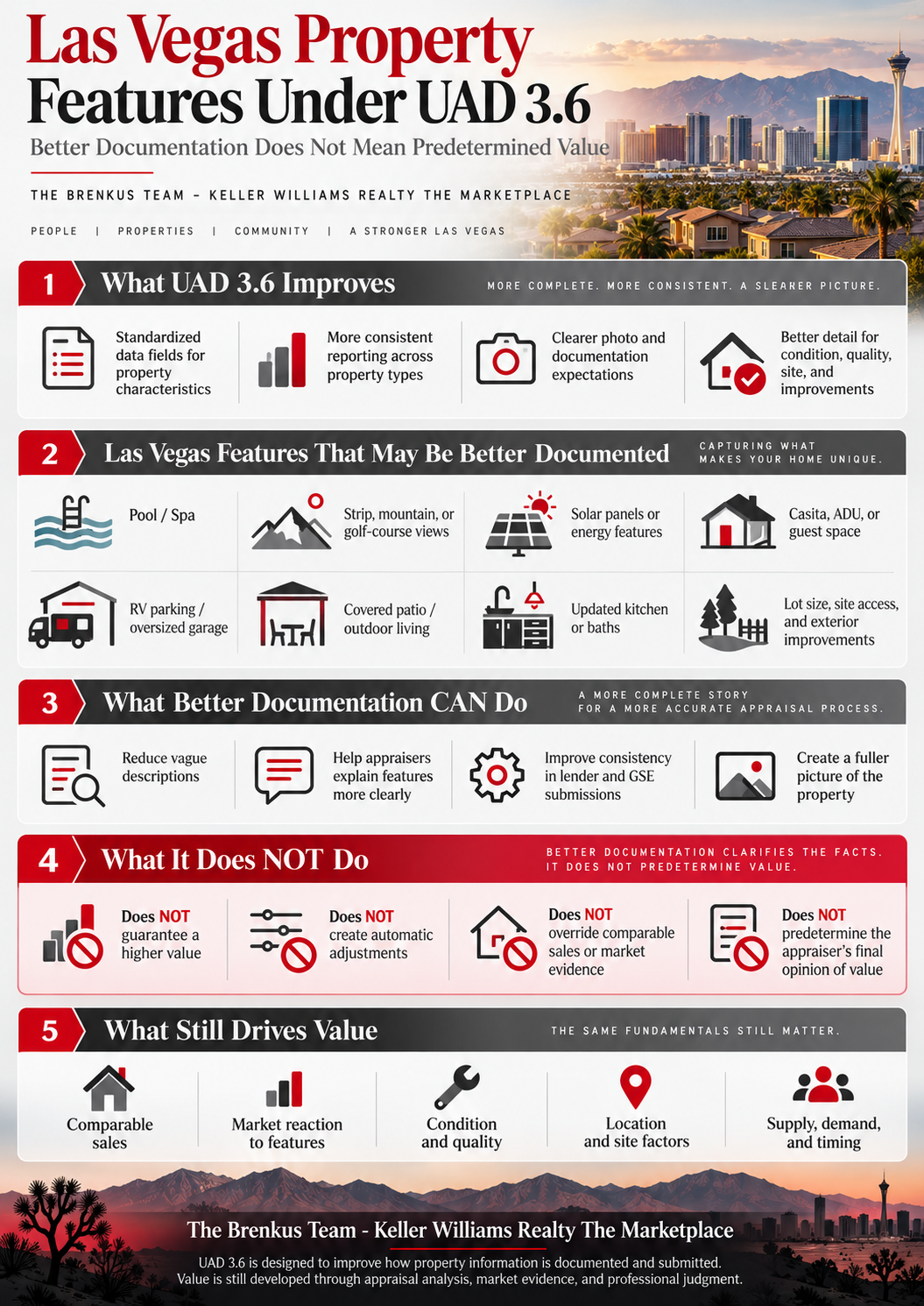
Answer Block: UAD 3.6 provides structured fields for capturing local property features—including dedicated sections for casitas/ADUs, explicit fields for solar ownership, and clear categorization for pool heating and community amenities. Better documentation does not equal predetermined monetary adjustments.
Southern Nevada features distinct architectural trends and submarket characteristics. UAD 3.6 provides dedicated structures to document these features accurately without relying on generic addenda notes.
UAD 3.6 Property Feature Reporting Breakdown
Standardized data field treatments for specialized residential features under the MISMO 3.6 URAR dataset
MISMO 3.6
Data Architecture
ANSI Z765
Gross Living Area Standard
Discrete Fields
Structured Data Picklists
← Scroll table horizontally to view full details →
| Property Feature | UAD 3.6 Standard UAD 3.6 Reporting Treatment |
|---|---|
| Casitas & Accessory Dwelling Units (ADUs) | Captured in a dedicated ADU section detailing living area, kitchen facilities, climate control, and entry access. |
| Solar Energy Systems (Leased vs. Owned) | Discrete fields record ownership (Owned vs. Leased vs. PPA), system capacity (kW output), and installation year. |
| In-Ground Swimming Pools & Spas | Standardized fields log pool construction, heating elements, integrated spas, and safety enclosures discretely. |
| Converted Garages & Enclosed Patios | ANSI Z765 guidelines classify space based on 7-ft ceilings, permanent heating/cooling, and permit documentation. |
| HOAs & Master-Planned Amenities (Summerlin, Henderson, Skye Canyon) |
Structured fields capture monthly dues, master policy coverage, and community security (gated, guard-gated, un-gated). |
| Specialized View Influences | Specific picklists distinguish Las Vegas Strip views, mountain backdrops, golf course frontage, or traffic influences. |
1. Casitas and Accessory Dwelling Units (ADUs)
Detached casitas and guest suites are common throughout Las Vegas master-planned communities like Summerlin, Cadence, and Inspirada. On legacy appraisal forms, appraisers often had to summarize guest quarters in a brief comment box.
UAD 3.6 introduces a dedicated, dynamic Accessory Dwelling Unit (ADU) framework as illustrated in GSE URAR Sample Scenario Reports. The report captures:
- Total finished square footage of the casita.
- Presence of separate kitchen or kitchenette facilities.
- Independent exterior access and climate control setups (e.g., mini-split vs. central HVAC).
- Separate valuation considerations distinguishing detached living space from primary living area.
2. Leased vs. Owned Solar Energy Systems
Rooftop solar installations are widely prevalent across Southern Nevada. UAD 3.6 requires explicit reporting of solar system ownership:
- Owned Solar Systems: System capacity (kW output), age, and ownership documentation are recorded in discrete data fields, allowing the appraiser to evaluate whether local market evidence supports a value adjustment for real property improvements.
- Leased Solar Systems or Power Purchase Agreements (PPAs): Under federal secondary market guidelines, leased solar equipment is personal property and cannot be added to the primary real property appraised value. UAD 3.6 captures the lease status clearly to ensure mortgage underwriters review the solar contract terms separately.
3. Pools, Spas, and Outdoor Living Space
In a desert climate, backyard pools, covered patios, and outdoor kitchens represent major investments. UAD 3.6 uses standardized picklists to record pool details—such as construction type (gunite vs. fiberglass), heating capability (gas, solar, electric), integrated spas, and safety barriers—discretely rather than lumping them together into broad general line items.
4. Converted Garages and Unpermitted Additions
Garage conversions and patio enclosures are frequent occurrences in established Las Vegas neighborhoods. Under UAD 3.6, appraisers follow standardized ANSI Z765 square footage rules:
- To be classified as finished gross living area (GLA), space must feature permanent heating and cooling systems, direct interior access, and ceiling heights meeting residential building codes (generally a minimum of 7 feet).
- If an addition lacks proper building permits or permanent HVAC, the appraiser logs it in a separate, unconditioned space field rather than combining it with primary living space.
5. Views and HOA Community Characteristics
Whether a property overlooks the Las Vegas Strip, backs up to Red Rock Canyon, or sits directly on a golf course in Lake Las Vegas, UAD 3.6 provides specific picklist categories to capture views and external influences. Furthermore, HOA dues, master-planned community amenities, and gate security levels (guard-gated vs. electronic gate vs. un-gated) are logged systematically.
CRITICAL RULE TO REMEMBER: Standardized data reporting does not equal a predetermined value adjustment. UAD 3.6 does not dictate that "a pool is automatically worth $25,000" or "a casita adds $50,000." Market value adjustments must always be supported by local paired-sales analysis in your specific submarket.
Seeing these local features categorized in detail raises a common question among Nevada consumers: Was this new appraisal system created by the state of Nevada?
Is UAD 3.6 a New Nevada Appraisal Law?
Answer Block: No. UAD 3.6 is a nationwide secondary mortgage market standard established by Fannie Mae and Freddie Mac under FHFA oversight. It is not a state statute, municipal ordinance, or administrative rule enacted by the Nevada Real Estate Division (NRED) or the Nevada Legislature.
When major industry rule updates take effect, consumers sometimes assume that local state regulators enacted new real estate laws.
- Federal Authority: UAD 3.6 is a federal mortgage delivery requirement established by Fannie Mae and Freddie Mac under FHFA direction. It governs how appraisals are formatted when lenders deliver conventional loans into the secondary mortgage market.
- State Licensing Authority: Local Las Vegas appraisers are licensed and regulated by the Nevada Real Estate Division (NRED) under Nevada Revised Statutes (NRS Chapter 645C). NRED enforces appraiser licensing, continuing education, and compliance with national Uniform Standards of Professional Appraisal Practice (USPAP).
- How They Intersect: Nevada appraisers adhere to UAD 3.6 specifications when completing assignments for mortgage lenders because those lenders require compliance with Fannie Mae and Freddie Mac guidelines. However, Nevada state authorities did not pass separate state legislation establishing UAD 3.6.
Because UAD 3.6 is tied directly to federal secondary mortgage market standards, it does not apply universally to every real estate transaction in Southern Nevada.
Does UAD 3.6 Apply to Every Home Appraisal?
Answer Block: UAD 3.6 applies directly to conventional conforming mortgages delivered to Fannie Mae and Freddie Mac. It is not immediately mandatory for government-backed loans (FHA, VA, USDA) on November 2, 2026, and it does not apply to cash purchases or private non-lender appraisals.
Does UAD 3.6 Apply to Your Transaction?
Mandate scope and regulatory applicability across mortgage financing and private appraisal categories
Nov 2, 2026
GSE Conforming Mandate
GSE Only
Current Enforced Mandate Scope
Exempt
Cash Sales & Private Appraisals
← Scroll table horizontally to view full matrix →
| Transaction / Financing Type | UAD 3.6 Mandate Status | Governing Authority / Notes |
|---|---|---|
| Conventional Conforming Loans | Mandatory Mandatory starting Nov 2, 2026 (with policy exceptions thru 2027) |
Fannie Mae & Freddie Mac under FHFA oversight. |
| FHA Loans (HUD) | Planned Adoption planned; mandatory date unannounced as of late 2026. |
HUD / Federal Housing Administration INFO Bulletins. |
| VA Loans | Planned Adoption planned; mandatory date unannounced as of late 2026. |
U.S. Department of Veterans Affairs Circulars. |
| USDA Loans | Planned Adoption planned; mandatory date unannounced as of late 2026. |
USDA Rural Development Guidelines. |
| Jumbo & Portfolio Loans | Investor Dependent Investor dependent. |
Determined by individual lending institutions purchasing private loans. |
| Cash Sales & Private Appraisals | Exempt EXEMPT |
Non-lender assignments (divorce, estate, tax appeals) follow USPAP. |
- Conventional Conforming Loans: Fully subject to the UAD 3.6 implementation schedule and UCDP portal mandates.
- FHA, VA, and USDA Loans: Government agencies have expressed commitment to adopting the UAD 3.6 dataset to align with industry standards. However, official mandatory transition dates for government-backed mortgages remain unannounced as of late 2026.
- Jumbo and Portfolio Financing: Lenders that keep mortgages on their own balance sheets (portfolio lenders) or sell loans to private jumbo investors determine their own report format requirements.
- Cash Sales and Private Appraisals: If a buyer is paying cash or a homeowner orders a private appraisal for estate planning, divorce settlement, or tax appeal purposes, UAD 3.6 portal delivery is not required. Private assignments operate under general USPAP standards.
If your upcoming transaction involves a mortgage that requires a UAD 3.6 appraisal, taking a few proactive steps can help ensure the appraiser has access to all factual property records.
How Las Vegas Sellers Can Prepare for an Appraisal
Answer Block: Las Vegas sellers should assemble an "Appraisal Information Packet" containing building permits, capital improvement receipts, solar ownership contracts, and HOA schedules. Sellers must provide objective facts without violating Appraiser Independence Requirements (AIR).
Preparing your home for an appraisal under UAD 3.6 does not require undertaking costly last-minute remodels. Instead, the goal is organizing factual documentation so the appraiser can accurately complete the structured fields in the new dynamic report.
The Appraisal Prep Checklist for Sellers
- Permits and Final Sign-Offs: Gather permit documentation for casitas, room additions, enclosed patios, or garage conversions.
- Capital Improvement Records: Compile a summary list of major upgrades completed within the last 5 to 10 years (e.g., roof replacement, HVAC upgrades, pool resurfacing, kitchen remodels), including approximate dates and costs.
- Solar Panel Documentation: Locate your solar paperwork clearly identifying whether the system is fully paid off (owned) or under a lease/PPA agreement, along with system size specs.
- HOA and Community Details: Provide current HOA fee schedules, CC&R documentation, master policy contacts, and community amenity details (gated access codes, clubhouse features).
- Property Access: Ensure all rooms, casitas, water heaters, HVAC units, and attic access panels are unlocked and easily accessible.
Las Vegas Seller Appraisal-Prep Checklist
Essential documentation and access preparation to streamline UAD 3.6 valuation reporting
5 Action Items
Core Verification Checklist
ANSI Z765
Living Area Compliance Standard
MISMO 3.6
Granular Feature Dataset
1. Permits & Inspection Sign-Offs Mandatory Verification
Casitas, room additions, and patio covers require documented building permits to verify GLA compliance and structural integrity.
2. Capital Improvement Summary Valuation Impact
HVAC replacements, roof condition, pool resurfacing, and kitchen/bath renovations with documented completion dates and itemized costs.
3. Solar Ownership Documentation Ownership Status
Clear agreement terms distinguishing owned systems from leased or Power Purchase Agreements (PPA), including kW system output capacity.
4. HOA Schedule & Community Details HOA Records
Monthly dues breakdown, gate access status (un-gated, gated, guard-gated), master policy contacts, and shared amenity schedules.
5. Easy Property Access Site Inspection
Clear, unobstructed pathways to casitas, water heaters, HVAC units, electrical panels, and pool equipment for mandatory photo requirements.
Respecting Appraiser Independence Requirements (AIR)
Under federal law and Fannie Mae's Appraiser Independence Requirements (AIR), real estate agents and sellers are fully encouraged to provide objective property facts, survey plats, improvement receipts, and market data packets to the appraiser.
However, sellers and agents must never pressure an appraiser to reach a specific valuation, request that an appraiser "hit" a contract purchase price, or condition payment on a valuation outcome. Maintaining absolute appraiser independence ensures a fair, compliant transaction for all parties.
Organizing objective property facts directly supports national efforts toward standardized, consistent real estate reporting.
Objective Data Standards, Fair Housing, and Appraisal Consistency
Answer Block: UAD 3.6 supports fair housing goals by replacing subjective narrative descriptions with standardized, objective data fields. This structured format promotes consistent evaluation across all residential property types without altering fair housing laws or dictating property values.
A primary motivation behind the FHFA's appraisal modernization initiative is enhancing consistency and objectivity across residential property evaluations.
- Replacing Subjective Phrasing With Fact-Based Terms: Legacy appraisals occasionally contained vague narrative descriptions that could inadvertently introduce bias or subjective interpretations. UAD 3.6 replaces open-ended commentary boxes with standardized picklists that focus strictly on observable property characteristics.
- Consistent Room-Level Documentation: By standardizing how condition ratings, interior updates, and architectural features are recorded nationwide, UAD 3.6 creates a verifiable dataset that allows lenders and federal regulators to review appraisal quality efficiently.
- Alignment with Fair Housing Principles: Federal Fair Housing laws prohibit basing property valuations on race, color, religion, sex, disability, familial status, or national origin. Standardized data structures ensure that appraisals focus exclusively on objective physical traits, location factors, and market transactions.
While UAD 3.6 does not "eliminate" valuation challenges on its own, establishing objective data standards marks a major step forward in creating a modern, transparent mortgage system.
Before concluding, let's address the most common misunderstandings surrounding UAD 3.6.
Top Consumer Misconceptions About UAD 3.6 Debunked
Misconception 1: "Las Vegas passed a new local appraisal law for 2026."
- FACT: False. UAD 3.6 is a nationwide secondary mortgage market standard created by Fannie Mae and Freddie Mac under federal FHFA oversight. It is not a state statute enacted by the Nevada Real Estate Division or Nevada Legislature.
Misconception 2: "UAD 3.6 automatically changes how much my home is worth."
- FACT: False. UAD 3.6 updates property data collection, room-level formatting, and electronic report transmission. The fundamental legal definition of market value and core paired-sales valuation math remain completely unchanged.
Misconception 3: "Every appraisal switches to UAD 3.6 on November 2, 2026."
- FACT: Misleading. While November 2, 2026 is the general mandatory date for conventional conforming loans, the September 30 policy exception allows qualifying lenders operating under specific risk conditions to submit legacy reports into early 2027, with complete legacy retirement occurring June 28, 2027.
Misconception 4: "FHA and VA loans follow the exact same timeline as Fannie Mae."
- FACT: False. While FHA, VA, and USDA plan to adopt the UAD 3.6 standard, mandatory implementation dates for government-backed mortgages have not yet been established as of late 2026.
Misconception 5: "UAD 3.6 assigns predetermined values to pools, solar panels, or casitas."
- FACT: False. Standardized data reporting does not equal predetermined monetary values. Appraisers use UAD 3.6 to describe property features clearly, but dollar adjustments must still be derived from local market evidence in your specific Las Vegas submarket.
Conclusion: Navigating Appraisal Modernization with Confidence
As you stand in that Summerlin or Henderson kitchen while an appraiser walks through your home, the physical process looks reassuringly familiar.
The pool is still the same pool.
The casita is still the same casita.
The comparable sales driving your valuation still come from real buyers and sellers making real transactions across Southern Nevada.
What is changing is the modern, dynamic digital framework used to document, structure, and communicate those property facts to your lender. By replacing outdated paper-era forms with plain-English picklists and standardized data fields, UAD 3.6 brings greater clarity and consistency to the real estate appraisal process.
If you are preparing to buy or sell a home in Las Vegas and have questions about how the appraisal process fits into your overall transaction, The Brenkus Team can help you understand the process, organize relevant property facts, and guide you smoothly through every step of buying or selling your home.
About The Author
Gavin Brenkus | Lead Agent & Director of Lead Generation
A three-time recipient of the prestigious "Who's Who Under 40" award from Las Vegas REALTORS®, Gavin Brenkus has firmly established himself as one of the most accomplished real estate professionals in Southern Nevada. As a Lead Agent and the Director of Lead Generation for The Brenkus Team, he is an integral part of a family-owned legacy that has achieved nearly $2 billion in sales volume and successfully closed over 8,000 transactions.
For Gavin, real estate is more than a profession—it's a lifelong passion. Immersed in the industry from the age of 16 and licensed before graduating high school, he offers a rare depth of market knowledge that combines youthful energy with decades of absorbed expertise.
His professional philosophy is built on a foundation of listening. Gavin is dedicated to fully understanding the unique wants and concerns of his clients, allowing him to curate a tailored and seamless experience from start to finish. This client-first approach ensures that everyone he works with feels heard, valued, and expertly guided.

Brenkus Team
| The Brenkus Team | Keller Williams Realty The Marketplace
or another way